Today we all headed south of Richmond to Chester, VA to meet up with a friend of Larry's. Kevin and his wife Nancy and their children Sydney, Camilla, and Charles. We had a good breakfast, stuffed ourselves and afterwards headed off to a good walk in the forest to a James River overlook. We ended up at yet another site, Drewry's Bluff, a perfect Gibraltar.
Drewry's Bluff was initially designated as a military post and later expanded into a military city. Eventually supporting structures were built and the Confederate Naval Academy actually held classes. There was even a steamship that brought civilians down from Richmond for picnics on the weekend where they could sit and watch the sailors and Marines drill.


Bill and I were up ahead on this trail to the bluff.


May 15, 1862 The Battle of Drewry's Bluff. The bluff, perfectly situated above the James River, was a perfect defense site protecting Richmond from Union attack. The Confederacy strategically sunk ships, built stones cribs as river obstructions for the coming Union's USS Galena. When the Galena approached Drewry's Bluff, the Confederate fired upon the Galena who responded by turning broadside to the bluff and opening fire with the ship's cannons. The battle lasted for four hours and eventually the U.S. Navy retreated down river, never again to challenge Drewry's Bluff.


These old photos of the post show almost no trees. Careful Sherry, you've got a cannon aimed at you.

After the War the Confederacy abandoned the post but it did not remain vacant for long. The Union troops immediately took possession of the fort that for three years had barred their way to Richmond.
A parting shot of the wonderful young family that showed us to this interesting historical site and lush forest.

Next stop along the way into Richmond is the Hollywood Cemetery. What a magnificent find. OK Duane, don't get all worked up over another cemetery. The Richmond skyline where we'll go later.

Why another cemetery? The interest in this one is two President's are buried here, James Monroe, our 5th President (1758–1831), and John Tyler, our 10th President (1790–1862). Also buried here is the only Confederate President Jefferson Davis.

There are a kazillion graves and crypts and monuments on this 130 acres. The Confederacy section has over 17,000 soldiers buried.

Following the "blue line" we found the President's Circle.

Even I found the President's Circle.


The Monument to President John Tyler.


Some photos of the cemetery.


Confederate President Jefferson Davis.


Beautiful crypts.

Skyline of Richmond from the Hollywood Cemetery.


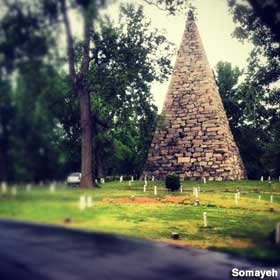
This is a picture I copied out of an article on the monument to the soldiers buried at Hollywood Cemetery. It appears from the people standing at the Randy and Sherry apparently found it, the rest of us never did. But here it is, honoring the over 17,000 soldiers buried here.


City Hall now and then, on a vintage postcard.


After leaving the Hollywood Cemetery we drove around downtown seeing some beautiful old buildings mixed with modern. We were looking for The Museum of The Confederacy and found it nestled in the hospital zone of Richmond, though I doubt it was always a hospital zone. It was originally residential and also the home of Jefferson Davis, known as the Confederate White House.

A good size house but unassuming for a "white house". It is now dwarfed in comparison to the huge medical facilities and hospitals towering over it.

Even today there is disagreement about what the arguing and fighting was all about. Slavery? No, not initially though it was an underlying element because those who had slaves had to keep them to perform the heavy labor to maintain their plantations and thus to maintain the incoming wealth and outgoing exports. Actually this friction had been going on since 1787 and the drafting of the Constitution. The South and North always at odds over a growing list of aggravations.
With the election of Abraham Lincoln, southerns felt the "South's interest" were threatened. So in the winter of 1860-1861 seven southern states left the Union and formed the Confederate States of America. So the Union slapped them with high tariffs to subsidize federal internal improvements...policies that the South resisted. There would also be no expansion of slavery into the western territories.

Your list of troublemakers.
Most historians believe that the primary issue with Abraham Lincoln was the unity of the states and that he was seriously opposed to any secession. The South believed the Constitution allowed for secession, Abraham Lincoln disputed it and was determined not to let any state secede. The initial 7 states had seceded but the situation really heated up when these states demanded control over federal property within their borders. Especially Fort Sumter (see earlier Blog) and Fort Pickens.
The Union hunkered down in Fort Sumter and finally on April 12, 1861 the Confederates fired the first shot on the Fort, thus starting the Civil War. President Lincoln called for 75,000 troops to suppress the "rebellion". The result was 6 more states seceded, now totaling 13.
Back to the Museum.
I selected a number of photos to include here. Not is any chronological order of events, just interesting information.
General Robert E. Lee (we'll visit his home in Virginia along the Potomac later) was Commander of the Virginia military forces in 1861. He had married Mary Custis, who had inherited Arlington House from her father George Washington Custis, adopted son of George Washington. He built the Arlington House in tribute to his Grandfather George Washington. To make a long story short, Lee refused the offer from President Lincoln to command the Federal Armies at the beginning of the Civil War and instead accepted President Davis' offer of command of the Confederate army. This act basically made Lee a traitor and Mary Custis Lee fled Washington. The Federal confiscated Arlington and started by burying 7000 soldiers in the gardens. The house is there and it's now a famous cemetery but more on that later.
 |
| General Robert E. Lee |

Lt. Gen. Stonewall Jackson and his commander General Robert E. Lee in a painting depicting their last meeting. On May 2, 1863, following an extremely successful attack and victory against the Union, Jackson was killed by "friendly fire" when his own troops mistakenly thought he was a Union soldier.

The Battle of Gettysburg, July 1-3, 1863 is the most well know battle of the Civil War. This three-day battle resulted in the most causalities of any battle in US history. On the third day of battle the Confederacy charged the Union line (known as Pickett's Charge) and barely pierced the line but resulting in heavy losses. 28,000 Confederate killed, wounded, missing or captured to the Union's 23,000. Many historians view this as Lee's and the Confederacy's "high tide", everything going down and out from here.
The Fall of Richmond was next. General Lee telegraphed President Davis on March 25, 1865 and warned him to evacuate Richmond with his family. On April 2 his warning was dire. Davis, his family, and his cabinet fled Richmond that same evening. The last confederate soldier leaving Richmond set fire to the warehouses and factories to prevent the Union from getting the supplies. The fire went out of control and burned most of the city. The Union was finally able to occupy Richmond, after four years of unsuccessful attempts.
General Lee headed to Lynchburg, VA to meet up with Gen. Joseph Johnston Army of Tennessee and continue the fighting. He and his troops were overtaken on April 9, 1865 at the Appomattox Court House. Over the next few days the terms of surrender were ironed out and on April 12, 1865 the 28,000 Confederate officers and men surrendered to the Federal, making Appomattox synonymous with the end of the Civil War. It wasn't until April 26, 1865 that the terms of surrender were ironed out for Gen. Johnston and his 31,000 troops to Gen. Sherman. Over the following weeks numerous Generals and their troops surrendered. Now the war was really over.
Further military resistance was pointless and with the capture of President Davis and his family in Irwinville, Georgia on May 10, 1865, the symbolic and effective end of the war was set.


That was just a smattering of info from the museum. We stumbled out, heads heavy with more knowledge. Did someone say the Capital was interesting? We went to find out and oh yes, gorgeous.


Top of the monument is George Washington, surrounded by famous Generals.


If I am ever going to get back on schedule I must end this visit here. I hope you enjoyed the history lesson and I hope I didn't mess up anything. Thanks for visiting. We head to Colonial Beach soon with visits to Fredericksburg, Robert Lee's home and the birthplace of George Washington. Did you know 3 of the first 5 presidents of the United States came from Virginia.
See you soon.


1 comment:
Your history lesson was great! I've been to many of these sites, but you tied them together for me--love the old cemeteries for history.
Thanks for your blog-
Schar
Post a Comment